Renewable technologies such as hydro energy, solar power or wind energy, are quite consistently labelled as harmless. When compared to other non-renewable energy sources this statement holds a lot of truth. However, renewable energies are not an instant fix to the problems of our energy systems.
By using the example of hydraulic power, I will go through some of the risks and consequences that renewable energies hold for the future. These risks are quite different to their fossil fuel counterparts as these renewable energies hold social and political importance as well as some underlying environmental consequences.
Hydropower is power created by the movement of falling or running water. The largest hydropower producers in the world are the countries with a large landmass frequently crossed by rivers (China, Brazil, USA, Russia).
This energy source is 100% renewable because none of the water disappears as the only resource used is the water’s motion. However, hydropower does nonetheless present certain risks and disadvantages.
The biggest disadvantage that renewable energies have is their relative price compared to fossil fuel sources of energy. This difference has hindered the adoption and penetration of clean energies on the market. However there are other disadvantages and risks for renewable energies, here I will loook into them by using hydropower as an example.
- Population displacement and the destruction of entire valleys
The creation of dams requires the flooding of a large portion of landmass. This entails the destruction of entire valleys and the displacement of large amounts of people. This social problem is highlighted at the 2004 UN symposium on hydropower and sustainable development in Beijing by Professor Michael Cernea. He exposed the social consequences of dam building in four main bullet points:
- Forced population displacement and impoverishment
- Boomtown formation around constructions
- Downstream unanticipated changes in agro-production systems
- Loss of cultural heritage assets
He concludes that these social problems can be partially prevented by a mind-set that sees negative externalities as potential risks instead of unavoidable. Mitigation of these risks can be achieved instead of simply trying to adapt to them.
- Modifications to flora and fauna
Obviously flooding a valley will result in the destruction of the flora and fauna present there. However, dam building also modifies the livelihood of the fauna present in the river itself as they now need to adapt to a lake environment.
- Dangers of dam failure
This risk is by far the most dangerous for humans. When a dam collapses, huge amounts of water are released downstream which results in flooding and destruction. In 1975, the Banqiao Dam in China broke. 171,000 people were killed and 11 million individuals lost their homes.
The next few months in the Henan Province of China were similar to the aftermath of a natural disaster: sickness was rampant, the water was dirty and millions of people had no shelter to sleep under.
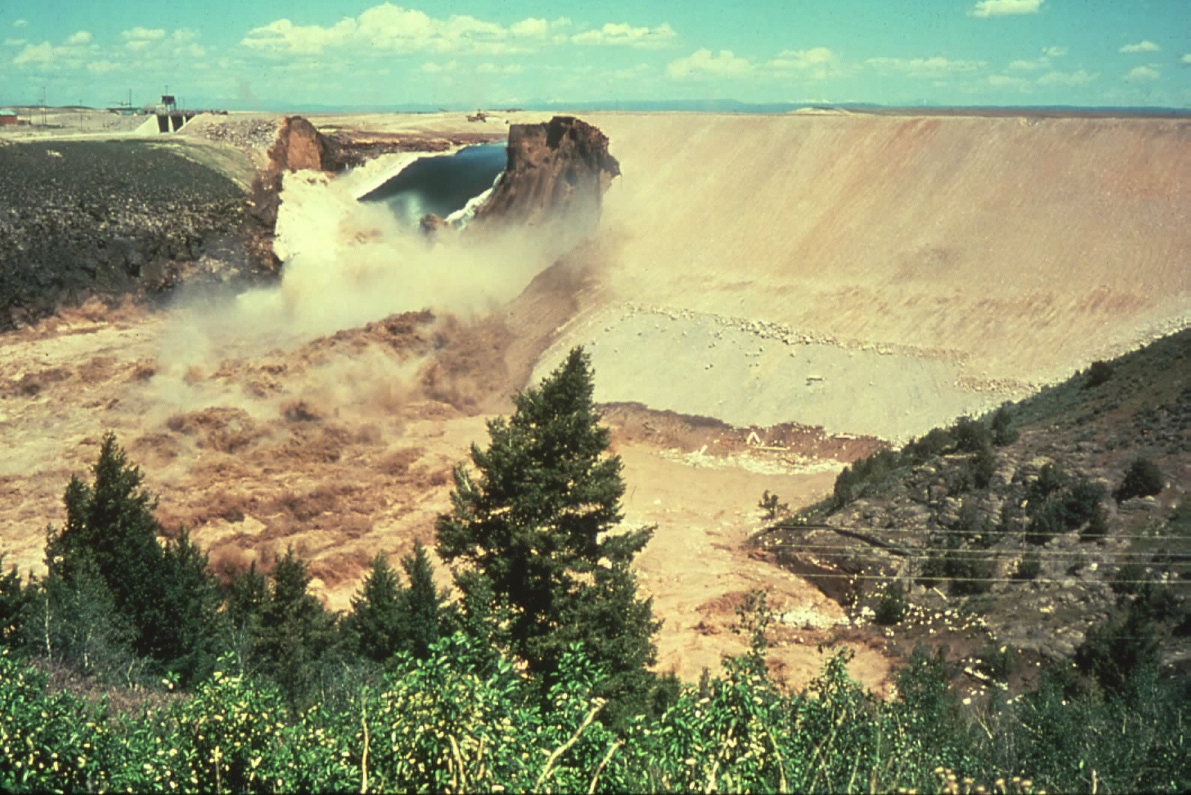
Failure of the Teton Dam in 1976
- Siltation
Siltation is the process of water pollution by fine material particulates. When water is flowing, it has the ability to carry particulates that are heavier than itself. When a dam is constructed on a river this phenomenon is no longer possible because the water is slowed down to a stop. The fine particulates therefore stay in the basin and the water becomes polluted. Studies have been conducted and explained the relationship between siltation and dams. Here is one led on the Gilgel Gibe Dam in Ethiopia.

The effects of siltation of a waterway
- Necessity of an eligible building spot
The fact that a particular geographic formation needs to be present (narrow part of a deep river valley) in order to build a dam means that other important criteria can be omitted. For example, a dam can be built in a location that is also prone to earthquakes or storms because perfect dam locations are not easy to find.
- Dams and their link to seismic activity
Many studies have been conducted to link unusual seismic activity to the construction of new dams. Indeed, the large reservoir of water created by a damm affects the underlying geology of the region. The Hoover Dam on the Colorado river (also known as the Boulder Dam) has been linked with new seismic shocks in the area. Similarly Lake Pukaki in New Zealand has induced seismicity.
Renewable energy sources are without doubt a less risk heavy alternative to our fossil fuel energy system. However, these new technologies still do carry social, political and environmental risks that cannot be ignored. As Professor Cernea indicated in his keynote address, they must be taken into account when investing in these technologies. Further, these risks should not be understood as inevitable consequences but instead as risks that we can overcome when prepared properly.
Further reading on social and environmental impacts of hydropower are available at the International Energy Agency internet site: http://www.ieahydro.org/Technical_Information_%3E_IEA_Hydropower_Agreement_Technical_Reports.html

No comments:
Post a Comment